
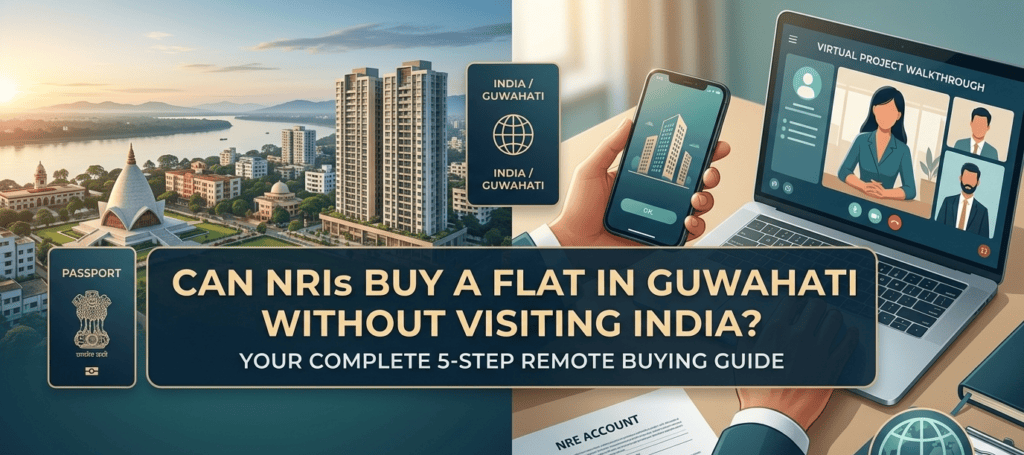
Are you wondering how NRIs buy a flat in Guwahati while living abroad? If your parents are getting older in India, you’re probably thinking about owning a home back where your roots are.
You’re in Dubai, or London, or Bangalore, working the kind of hours that don’t leave room for a two-week trip home.
But every time you visit, even for four days, you find yourself scrolling property listings at 1 AM, thinking: maybe it’s time to buy something back home.
Not to move in tomorrow. Just to have it. A place that’s yours in the city you grew up in.
And then the doubt creeps in.
Can I even buy a flat in Guwahati from another country?
Do I need to fly down for every signature?
Will the bank even give an NRI a home loan for a project in Assam?
If you’ve searched any of this, you’ve probably landed on generic guides written for NRIs buying in Mumbai or Bangalore. Useful, but not exactly built for someone whose roots and whose next flat are in Guwahati.
The good news is that NRIs buy a flat in Guwahati every year without travelling to India. With the right documents and a trusted developer, the entire process can be completed smoothly.
Yes, NRIs Can Legally Buy a Flat in Guwahati
Under FEMA (Foreign Exchange Management Act), any NRIs and OCI cardholders can purchase residential property in India under FEMA (Foreign Exchange Management Act, 1999) without prior RBI approval.
They cannot purchase:
- agricultural land
- plantation property
- farmhouse land
No special approval. No extra paperwork just because you’re abroad.
The only properties you can’t buy are agricultural land, farmhouses, and plantation land. A flat in a residential project like Auspire Achyut or Auspire Nivam doesn’t fall under that restriction at all.
This is one of the biggest reasons NRIs buy a flat in Guwahati for their families, future retirement, or long-term investment.
The part that actually needs planning is everything around it.
 Do You Need to Fly Down to Buy a Flat in Guwahati?
Many NRIs buy a flat in Guwahati without making multiple trips to India.
Here’s what can genuinely be done from wherever you are:
- Shortlisting the project and unit through video walkthroughs and calls
- Getting the floor plan, pricing, and RERA details shared digitally
- Signing the booking form and Agreement to Sell
- Making payments through your NRE or NRO account
Here’s what usually still needs someone physically present:
- The final registration at the Sub-Registrar’s office
- Site visits, if you want to see the actual construction before locking in
If you genuinely cannot travel, a registered Power of Attorney (PoA) lets a trusted person a parent, a sibling, a spouse complete the registration on your behalf. This is common, legal, and something most serious developers are used to handling.
PoA must be:
- notarised in the country of residence
- often apostilled/attested by the Indian Embassy/Consulate
For registration in Assam:
- Sub-Registrar usually requires a properly stamped PoA under the Assam Stamp Act rules
In short: you can book and pay for a flat in Guwahati entirely from abroad. You’ll likely need someone on the ground only for the final registration step, or a PoA if even that isn’t possible.
What Documents Do You Actually Need?
This is where most NRI buyers get stuck not because it’s complicated, but because nobody lists it out clearly. Here’s the real list:
- Valid passport
- OCI or PIO card (if you hold foreign citizenship)
- PAN card (mandatory for any property transaction in India)
- NRE or NRO bank account details
- Overseas address proof (utility bill, bank statement, or driving licence)
- Passport-size photographs
- Registered Power of Attorney, only if someone else will sign on your behalf
Having these documents ready makes it much easier when NRIs buy a flat in Guwahati, as most paperwork can be completed remotely. Keep these ready before you even start shortlisting. It saves weeks later.
Can You Get a Home Loan as an NRI for a Flat in Guwahati?
Yes. Most major Indian banks and NBFCs offer home loans to NRIs; NRI home loans in India typically finance around 70–80% of the property value, depending on the bank, borrower profile, and property type. In select cases, some lenders may offer higher financing, but this is not standard. Home financing is one of the reasons NRIs buy a flat in Guwahati instead of waiting until they permanently return to India.
A few things to know:
- EMIs are paid through your NRE or NRO account
- Interest rates for NRI home loans are generally aligned with resident Indian rates, though some lenders may charge a small premium depending on credit profile and country of residence. Final rates vary by bank and are subject to periodic change.
- Loan tenure usually goes up to 20–25 years, depending on your age and income
- You’ll need proof of overseas income salary slips, employment contract, or business proof
The remaining 20–25% comes as a down payment, either from your NRE/NRO savings or foreign remittance through proper banking channels. RBI rules are firm on one thing: money for the purchase has to move through legal banking routes, not informal transfers.
How Payments and Repatriation Work
A lot of NRIs assume that once money enters India, it’s stuck there. That’s not true.
- Payments for the flat must be made in Indian Rupees through your NRE, NRO, or FCNR account
- If you ever sell the flat later, Sale proceeds from residential property can be repatriated abroad, subject to FEMA conditions, tax compliance, and processing through an Authorised Dealer bank. Repatriation is generally permitted for up to two residential properties, provided the original investment was made through approved banking channels. Annual repatriation limits and documentation requirements may also apply depending on the case.
- Rental income, if you lease the flat out, is taxable in India and can also be repatriated after tax clearance
None of this needs to be figured out alone your bank’s NRI desk and the developer’s sales team usually walk you through it together.
Why Guwahati Specifically Makes Sense for NRIs Right Now
Most NRI property guides push you toward Mumbai, Bangalore, or Pune. Fair enough but if your family, your roots, and your eventual retirement plan are in Assam, buying there does something a metro flat never will: it keeps you connected to home while your money still works for you. There are several reasons NRIs buy a flat in Guwahati instead of choosing larger metro cities.
Guwahati’s advantage for NRI buyers specifically:
- Lower entry cost compared to metro cities, meaning your foreign savings stretch further
- A market that’s still catching up, not one that’s already peaked
- Family already nearby, in many cases so the flat gets used, checked on, and maintained even when you’re not around
- Two RERAA-registered options ready right now Auspire Achyut (RERAA KM 221 of 2024–2025) near Royal Global University, and Auspire Nivam (RERAA KM 65 of 2023–2024) in Ahom Gaon both handling NRI-style transactions on a regular basis
If the plan is “buy now, use it later, maybe retire into it eventually,” this is close to the ideal window prices haven’t caught up to what infrastructure growth in the city is about to bring.
A Simple Checklist Before You Commit
Before you transfer a single rupee, run through this:
- Is the project RERA registered? (Ask for the certificate number directly.)
- Is the developer used to working with NRI buyers, or will you be their first?
- Can they walk you through the process over video call, not just phone calls?
- Do they have a clear process for PoA-based registration?
- Is the payment schedule linked to construction milestones, not arbitrary dates?
If a developer hesitates on any of these, that’s your answer.
Final Thought
Buying a flat in Guwahati while sitting in another country can feel like a leap. But strip away the confusion, and it’s really just five things: legal eligibility (already sorted for you), documents (a one-time checklist), funding (NRE/NRO plus a home loan if needed), a trustworthy PoA if you can’t travel, and a developer who’s transparent enough to make the rest easy.
For most families, NRIs buy a flat not just as an investment but as a way of staying connected to home. It’s about keeping a door open back home one that’s ready whenever you are. If you’re planning to buy a home in Assam, understanding how NRIs buy a flat remotely can save both time and unnecessary travel.
Talk to our team about NRI documentation and payment process for Auspire Achyut or Auspire Nivam – we handle this over video call regularly.
FAQs
Can NRIs buy a flat in Guwahati without visiting India?
Yes. Booking, documentation, and payments can be done remotely through your NRE/NRO account. Only the final registration typically needs someone present, and even that can be handled through a registered Power of Attorney.
What documents does an NRI need to buy property in Guwahati?
A valid passport, OCI/PIO card (if applicable), PAN card, NRE/NRO account details, overseas address proof, and a registered PoA if someone else is signing on your behalf.
Can NRIs get a home loan for a flat in Guwahati?
Yes. Most Indian banks offer NRI home loans covering 75–80% of the property value, repayable through NRE or NRO accounts.
Can NRIs repatriate money after selling a property in Guwahati?
Yes, sale proceeds from up to two residential properties can be repatriated abroad, provided the original purchase was made through proper banking channels.